
| Shares: 755M at 24 Aug 2023 | |
| Date / Location of update |
Comments |
| 27th January 2025 Weekly (Stock price: A$3.01) |
The stock price of RRL, a mid-tier gold producer based in Western Australia, is up by only 5% since the stock’s inclusion in the TSI List in 2021. However, the stock price has doubled since its bottom last August, despite no company-specific positive fundamental changes. The extreme relative strength over the past 5-6 months was solely the result of a sentiment change.
We have written multiple times that the company’s cash-flow generation potential suggested a share price target of around A$4.00/share. That’s still the case, so at last week’s closing price of A$3.01 there is still plenty of valuation-related upside potential. However, there is also significant risk. In addition to the usual mining risks and the risk of a management misstep, about a year ago RRL put out a press release regarding a claim for royalties on the Tropicana gold mine, a project in which RRL purchased a 30% stake a few years ago, by South32. Although RRL owns only 30% of Tropicana, when it purchased this stake it indemnified the seller (IGO) against any royalty claims on 100% of the property. South32’s claim is with the Supreme Court of Western Australia. RRL believes that the claim has no merit and therefore does not believe that it has any liability associated with the royalties that are the subject of the claim, but South32, a major mining company, would not have commenced the legal proceedings unless it believed it had a case. Given the amount of cash that RRL is now generating, a negative outcome from this court case would be a significant but not a major setback for the company. It would not stop us from buying/owning the stock if it were still trading at A$2.00/share, but at A$3.00/share it adds enough to the risk to make the risk/reward unattractive. Like Regis Resources (RRL.AX), Ramelius Resources (RMS.AX) is a mid-tier gold producer based in Western Australia. Its size is similar to that of RRL, but at current prices its valuation is a little lower. More importantly, at current prices its risk/reward is more attractive by virtue of its lower risk due to its stronger balance sheet, lower production costs and the absence of any known legal threats. We are not going to add RMS at this time. Instead, we plan to add the stock to the TSI List if its price drops to the low-A$2 area within the next three months. We will do a more detailed write-up at that time. |
| 20th January 2025 Weekly (Stock price: A$2.97) |
Regis Resources (RRL.AX) advised that it has used part of its large cash reserve (A$529M at 31st December) to pay off its A$300M syndicated loan facility. This is a good use of the company’s financial resources. Also, the company advised that it is well advanced in negotiations for the establishment of a Revolving Credit Facility to provide ongoing flexibility and additional liquidity. |
| 13th January 2025 Weekly (Stock price: A$2.76) |
Regis Resources (RRL.AX) advised that it achieved a record build-up of cash and bullion of A$149 million in the quarter ending 31 December 2024, resulting in a record cash and bullion balance of A$529 million at 31st December 2024. This obviously is good news, albeit not surprising given the high level of the A$ gold price. It also reported that gold production during the quarter was 101.3K ounces, which means that the company is on track to exceed the top end of its FY2025 production guidance range of 350K-380K ounces. This also is good news. |
| 28th October 2024 Weekly (Stock price: A$2.80) |
Regis Resources (RRL.AX) issued its Quarterly Activities Report for the September quarter (the first quarter of FY2025). According to this report, gold production during the quarter was 95K ounces at an AISC of A$2363/oz (US$1583/oz), which keeps the company on track to achieve its annual guidance.
Apart from the gold production cost, there was no salient information in the report that had not been announced previously. The following chart shows that there has been an extraordinary rally in RRL’s stock price over the past two months and especially over the past two weeks. With reference to the following daily chart, the price bottomed in the low-A$1.50s in mid-August in response to the news that the company’s McPhillamys Gold Project would not be able to proceed to construction due to a federal government ruling. We noted at the time that this was not particularly bearish and highlighted the stock as a good candidate for new buying, at prices ranging from A$1.60/share to A$1.95/share, nine times between early-August and early-October. Sometimes it takes the stock market a while to catch on. Thanks to the recent strong rally, holders of RRL shares naturally will be feeling better about their positions. However, the risk is much higher and the short-term upside potential is much lower now with stock price at A$2.80 than it was a few weeks ago with the stock price at A$1.80. The stock is now a good candidate for some profit-taking. |
| 14th October 2024 Weekly (Stock price: A$2.16) |
Regis Resources (RRL.AX) reported that it produced 95K ounces of gold and added A$85M of cash to its balance sheet during the September quarter (the first quarter of FY2025). The production was in line with the company’s FY2025 guidance.
The latest quarter’s substantial cash build was similar to that of the preceding quarter. Further to a comment we made a few months ago, we think that it justifies a stock price well in excess of A$4.00. |
| 26th August 2024 Weekly (Stock price: A$1.77) |
Regis Resources (RRL.AX) announced that Tanya Plibersek, Australia’s Federal Minister for Environment and Water, has made a declaration of protection over part of RRL’s McPhillamys Gold Project site. This is despite the project already having been assessed and approved under both State and Commonwealth legislation.
The Minister stated that the declaration “will not stop the mine”. This indicates that she is either a liar or ignorant of important issues about which she should be aware, because the declaration will stop the mine and has forced RRL to do a large asset write-down (around A$190M). While this news is negative, it does have an upside in that it should prevent RRL’s management from directing additional financial resources towards a project with marginal economics. As we mentioned in a previous commentary, we don’t think that the economics of this project are good enough to warrant its further development. We would much prefer that management focussed on extracting maximum value from its current mines and returning more money to shareholders via dividends. Also, RRL issued its annual financial statements for FY2024. The McPhillamys write-off led to a large bottom-line loss, but as discussed below the company had substantial positive cash-flow during the past six months. The balance sheet included with the aforementioned statements shows that at 30th June 2024 the company had A$28M of working capital and no long-term debt, meaning that it had net working capital of $28M. At 31st December 2023 it had net debt of $137M, so there was a $165M balance sheet improvement during the six months ending 30th June. This was a good result that was achieved despite a rain-related disruption to production during the period. We are disappointed that RRL’s management did not declare a dividend. With strong cash-flow generation and the reduction in future capital investment that will be caused by the inability to develop the McPhillamys project, we would have thought that a significant dividend would have been paid. |
| 29th July 2024 Weekly (Stock price: A$1.67) |
Regis Resources (RRL.AX), a mid-tier gold producer with operations in Western Australia, announced the results of the FS for its McPhillamys Gold Project (MGP) in New South Wales. The MGP has the potential to be developed into an open-pit gold mine that produces an average of 187K ounces/year.
According to the FS, the MGP would produce gold at an AISC of A$1580 (US$1060 at the current exchange rate) per ounce. This is low relative to the industry-wide average cost of gold production. The problem is that the pre-production capex is estimated to be around A$1B, which is high for a mine of this size. Due to the high initial capex, the MGP’s economics are not attractive when assuming a gold price of A$3,000/oz (US$2,000/oz). Specifically, the post-tax NPV(5.5%) and IRR are estimated to be A$451M and 13.1%, respectively. These figures suggest to us that the project should not proceed to the construction phase anytime soon. Fortunately, RRL’s management is saying that a final investment decision won’t be made for this project until FY2026, which means no sooner than the second half of the 2025 calendar year. This means that it won’t be a significant drain on the company’s financial resources over the next 12 months. Separately, RRL announced its quarterly results and its FY2025 production guidance (its guidance for the period from 1st July 2024 through to 30th June 2025). Production during the June-2024 quarter was satisfactory and resulted in annual production (for FY2024) of 418K ounces, which was near the bottom end of the company’s guidance. More importantly, free cash flow generation was exceptional. Excluding a $20M tax refund, the company added A$89M to its balance sheet during the quarter. However, production guidance for FY2025 was very disappointing. Management expects FY2025 production to be 350K-380K ounces at the very high AISC of A$2440-$2740/oz. The FY2025 guidance came as a surprise and caused the stock price to be relatively weak. We will wait to review the company’s FY2024 annual report next month, but we are almost ready to give up on RRL. |
| 15th July 2024 Weekly (Stock price: A$1.94) |
Regis Resources (RRL.AX) advised that it produced 106K ounces of gold during the June-2024 quarter, bringing its production for the full 2024 Financial Year (FY) to 418K ounces. The full FY production was at the bottom end of the company’s guidance due to a major rain event during March-April of this year that adversely affected mines throughout the Western Australian goldfields.
Also, the company reported that it added A$109M of cash and bullion to its balance sheet during the June quarter, boosting its cash-plus-bullion position to A$295M. The $109M addition includes a $20M tax refund, so the mining operations generated A$89M of free cash-flow during the quarter. This is an excellent result. It is the sort of cash generation that we hoped and expected the company would achieve following the closing-out of its gold hedges at the end of 2023. If the June-2024 quarter’s operational cash generation (A$89M) is repeatable, then RRL would be fairly valued at A$4.50-$5.00. Last week’s closing price was A$1.94. The main reason for the current huge discount is the market’s scepticism about the repeatability of the last quarter’s impressive cash in-flow. This scepticism is rooted in a history marred by regular operational disappointments, with the occasional good quarterly performance being separated by multiple quarters of poor performance. Hopefully RRL’s management will have the good sense to declare a meaningful dividend in response to the company’s current strong cash generation. |
| 10th July 2024 Interim (Stock price: A$1.88) |
Regis Resources (RRL.AX). Shares: 755M. Recent price: A$1.88
RRL is a mid-tier gold producer with operations in Western Australia. Late last year it closed out a gold forward sales book that had been weighing on its financial performance for several years, paving the way for the company to be strongly profitable during the 2024 calendar year. The benefits of having closed out the hedge book have only just started to become apparent in the company’s financial performance. RRL is a relatively low-risk gold miner with intermediate-term upside potential in excess of 100%, which justifies its continued inclusion in the TSI List. It is a good candidate for new buying near its current price. |
| 13th May 2024 Weekly (Stock price: A$2.11) |
Regis Resources (RRL.AX) announced that it is proceeding with the development of two new underground gold mines at its Duketon project in Western Australia. Development will begin immediately, total pre-production capex is estimated to be around A$135M, and production at the combined rate of around 100K ounces/year at an AISC of around A$2200/oz is expected to begin in FY2027 (the 12-month period from mid-2026 to mid-2027).
We view this news as slightly negative. The new mines potentially will generate additional cash-flow a few years from now but will reduce the company’s ability to return money to shareholders over the next two years. Not all corporate growth is worthwhile. On the contrary, sometimes it makes more sense for a company to shrink in order to return more money to shareholders (the owners of the company). Mining companies that continue to increase production or invest enough every year to maintain production at current levels without increasing the money returned to shareholders are being run primarily for the benefit of management. There is an incentive for company managers who are not substantial shareholders to have an all-encompassing focus on growth, but there are times when it makes more sense to milk the existing assets for all they are worth as quickly as possible. |
| 29th April 2024 Weekly (Stock price: A$2.21) |
Regis Resources (RRL.AX), a mid-tier Australian gold producer, issued its Quarterly Report for the March-2024 quarter (the third quarter of FY2024).
Quarterly gold production was 10-15K ounces below plan at 91K ounces and the AISC was well above plan at A$2735/oz. This poor operational performance was due primarily to unusually heavy rainfall in the Goldfields region of Western Australia during the quarter. Despite the poor performance during the March quarter, the company was able to boost its cash+bullion by A$31M to A$186M and still expects to achieve its annual guidance of 415K-455K ounces at an AISC of A$1995-$2315/oz. Although this news is negative, it was expected and was factored into the stock price prior to last week. |
| 8th April 2024 Weekly (Stock price: A$2.05) |
Regis Resources (RRL.AX) advised that the pre-production capex to be included in the FS for its development-stage McPhillamys gold project in NSW would be around A$1B, which is almost double the amount that some analysts have been factoring into their models. The increase is due to scope changes and the massive inflation that has occurred since the 2017 PFS.
The FS is now scheduled for completion around the middle of this year and the permitting process is expected to be complete about 6 months later, potentially putting the company in the position to consider a Final Investment Decision (FID) for McPhillamys late this year. Due to the increase in the gold price it’s likely that the FS will indicate that the economics for the McPhillamys project remain robust despite the capex blow-out. However, it could make more sense for RRL to focus on generating cash from its existing mines, to be returned to shareholders in the form of dividends, than to build a large new mine. This news, while negative, doesn’t significantly affect our RRL valuation. |
| 25th March 2024 Interim (Stock price: A$1.85) |
Regis Resources (RRL.AX) advised that unusually heavy rainfall had disrupted production temporarily at its gold mining operations in Western Australia. As a result, production during the March-2024 quarter is expected to be 10K-15K ounces below plan at 90K-95K ounces. However, the company still expects to achieve its annual production guidance of 415K-455K ounces. |
| 6th March 2024 Interim (Stock price: A$1.97) |
The strength in the A$ gold price discussed above is very good news for unhedged Australian gold producers, of which there are two in the TSI Stocks List: Regis Resources (RRL.AX) and Westgold Resources (WGX.AX). Daily charts of these stocks are displayed below.
WGX’s performance reflects the strong A$ gold market, with the stock price having just tested its 3-year high and risen to within 20% of its all-time high. However, RRL has been a laggard. This can be at least partly explained by the fact that until the end of last year RRL’s financial performance was weighed down by a burdensome hedge book, whereas WGX has been hedge free since last August and prior to that its hedges did not impose a large cost. The recent difference in the performances of the above-mentioned stocks has created an opportunity to shift some money from WGX to RRL in anticipation of a catch-up move by the latter. |
| 26th February 2024 Weekly (Stock price: A$1.81) |
Regis Resources (RRL.AX) issued its Half Yearly (HY) report for FY2024 (the financial year ending 30th June 2024).
Most of the salient information in the HY report had been provided previously as part of the December quarterly report issued about one month ago. Of particular importance, a cost of A$179M associated with the hedge book, including a realised loss on gold delivered into hedges and the lump sum paid to eliminate all remaining hedges, had been flagged last month in the quarterly report. Removing this cost shows the cash and profit that RRL should be able to generate from the current quarter onwards. For example, the figures presented in the HY report suggest to us that at the current gold price RRL should be able to generate annual pre-tax profit of around A$200M. This, we think, would justify a stock price in excess of A$3.00. After incurring the above-mentioned hedge-related cost during the December-2023 quarter, RRL was left with net debt of A$145M. With no additional hedge-related costs to come it should be possible for RRL to fully eliminate this debt during the current half year. However, we would prefer that the company paid-off only a portion of its debt and used its cash-flow to pay a meaningful dividend to shareholders. |
| 5th February 2024 Weekly (Stock price: A$2.03) |
Regis Resources (RRL.AX) announced on Thursday of last week that its 30% stake in the Tropicana gold project is subject to a royalty claim from South32.
South32 is claiming in a legal action that IGO, the company from which RRL purchased its Tropicana stake in May-2021, is liable to pay royalties to South32 concerning the mining operations at the Tropicana Gold Mine amounting to about A$122M for the period from December-2014 until September-2023. RRL is involved because when RRL purchased its Tropicana stake from IGO it indemnified IGO against royalty-related claims from 31st May 2021 onwards. RRL’s potential liability associated with this period is estimated to be A$35M-$40M. Investors sold first and asked questions later when this news was announced, causing the RRL stock price to plunge by almost 10%. After the appropriate questions were asked it was determined that the most likely case was no additional cost to RRL and the worst case was an additional cost of about A$0.05/share. The RRL share price then retraced the bulk of its news-related plunge. |
| 29th January 2024 Weekly (Stock price: A$2.16) |
Regis Resources (RRL.AX), a mid-tier Australian gold producer, issued its Quarterly Report for the December-2023 quarter (the second quarter of FY2024).
Quarterly gold production of 109K ounces was in line with guidance and the company reiterated its FY2024 production guidance of 415K-455K ounces. The most significant elements of the report related to the hedge book and the change in cash+bullion. In particular, the company reported a A$179M cost associated with the hedge book during the quarter, including a realised loss on gold delivered into hedges and the lump sum paid to eliminate all remaining hedges. Without these hedge-related costs, RRL would have added A$91M of cash to its balance sheet during the quarter. Since there will be no more hedge-related costs, the aforementioned A$91M should be a rough indication of the amount of cash that RRL will generate over the quarters ahead assuming that the A$-denominated gold price stays around its current level. Assuming annual cash flow of around A$360M (approximately four times A$91M) and applying a conservative multiple of 8 to this cash flow gives us a potential value per share of around A$3.80. This suggests that RRL’s stock price has substantial valuation-related upside potential assuming no change in the gold price. |
| 17th January 2024 Interim (Stock price: A$2.07) |
RRL is a mid-tier gold producer with operations in Western Australia. It recently closed out a gold forward sales book that had been weighing on its financial performance for several years. This paves the way for the company to be strongly profitable during the 2024 calendar year, although it will report a loss for the December-2023 quarter due to the cost of the aforementioned hedge book closure.
RRL is a relatively low-risk gold miner with intermediate-term upside potential of at least 50%, which justifies its continued inclusion in the TSI List. Furthermore, the elimination of the hedge book should enable the company to pay a meaningful dividend this year. |
| 18th December 2023 Weekly (Stock price: A$2.07) | Regis Resources (RRL.AX) announced that it has closed out its gold hedge book. The immediate cost of closing out the remaining gold forward sales contracts was A$98M, which has been funded from the company’s existing cash. This cost would have been incurred during the first seven months of next year as gold was delivered into the forward sales contracts, so it is a brought-forward cost rather than an additional cost.
The gold forward sales book established by RRL several years ago could be aptly described as a disaster. It has been a classic case of sell-low/buy-high and has resulted in hundreds of millions of dollars of losses for the company. It is the main reason that the stock price recently traded near a 10-year low despite the AUD-denominated gold price being at an all-time high. The closure of the hedge book will result in a loss being reported for the December-2023 quarter but means that the company should be very profitable from the beginning of the 2024 calendar year. It also means that the company should become a significant dividend payer next year. In general, it could make sense for a gold producer to forward-sell up to 50% of the coming year’s production, assuming that the selling is done when the gold market is overbought. However, it never makes sense for a producer to forward-sell a significant amount of gold beyond the next 12 months. A gold producer that forward sells its gold years in advance runs the risk of being bankrupted by a large rise in the gold price. |
| 30th October 2023 Weekly (Stock price: A$1.72) | Regis Resources (RRL.AX), a mid-tier Australian gold producer, announced that it has signed an amendment deed with its lenders to extend the maturity date of its existing A$300M syndicated loan facility from 31 May 2024 to 30 June 2025. The terms and conditions of the amended facility are consistent with the previous ones, except that the minimum cash and bullion balance requirement will increase from the current $50M to $100M from 1 July 2024 through to 31 December 2024, and $150M thereafter. This is positive news.
The expectation is that the above-mentioned loan will be refinanced next year as part of a construction financing package for the company’s McPhillamys gold project. Also, RRL reported quarterly results that were in line with guidance, such as production of 111K ounces of gold at an AISC of A$2,106 (including A$140/oz of non-cash inventory adjustment). The company’s hedge book again weighed heavily on financial performance, but despite the A$41M loss associated with the gold hedges RRL managed to increase its cash/bullion holdings from A$243M to A$250M. All remaining gold hedges will be eliminated by 30th June 2024, paving the way for much greater cash generation from July-2024 onward. |
| 28th August 2023 Weekly (Stock price: A$1.52) | Regis Resources (RRL.AX), a mid-tier Australian gold producer, issued its report for the Financial Year ending 30th June 2023 (FY2023).
Most of the salient information to do with production and production guidance had been provided previously with the latest quarterly report. Of particular significance, this is what we wrote about the disappointing FY2024 guidance included in the quarterly report: “FY2024 guidance is for total production of 415K-455K ounces of gold at an AISC of A$1995-$2315/oz (US$1335-$1550/oz at the current exchange rate). This means that the mid-point of the FY24 forecast production quantity is about 20K ounces below the FY23 number and that the mid-point of the FY24 AISC is about A$350 above the FY23 number. The big production cost increase is the critical issue. From a free cash-flow perspective, RRL should perform better in FY24 than the above-mentioned guidance suggests. One reason is that A$200/oz of the projected FY24 AISC is a non-cash inventory adjustment. A second reason is that growth capital is expected to fall from A$230M in FY23 to A$90M in FY24.” In the annual report, the new information of greatest interest to us is the balance sheet. The balance sheet shows that working capital plunged from positive A$188M to negative $13M during FY23 due to about A$300M of debt being moved from Non-Current Liabilities to Current Liabilities. However, it also shows that long-term debt dropped from A$296M to zero. As a result, net debt (working capital minus long-term debt) improved from A$108M to A$13M. A syndicated debt facility of A$300M will have to be refinanced by 31st May 2024. Given the company’s current financial resources (including $240M of cash) and expected cash flow, this should not be a problem. RRL.AX is a buy near its current price, but WGX.AX is better positioned to take advantage of the high A$-denominated gold price. The reason is that WGX is now unhedged, whereas RRL has 120K ounces to be delivered into low-priced forward sales during FY24. |
| 31st July 2023 Weekly (Stock price: A$1.71) | Regis Resources (RRL.AX), a mid-tier Australian gold producer, issued its quarterly report for the June-2023 quarter (the final quarter of FY2023). Thanks to a good production result of 122.5K ounces during the quarter, the company managed to meet the bottom end of its annual production guidance (it produced 458K ounces in FY2023, 8K ounces above the bottom of its guidance range). The annual AISC was A$1805, which was well above the top of the original guidance range but near the bottom of the downgraded guidance provided in April.
Importantly, the company increased the sum of its cash and bullion from A$204M to A$243M during the June-2023 quarter. The reason for the stock market’s big negative reaction to the quarterly report wasn’t the information about performance over the past quarter; it was the FY2024 guidance that was also included. FY2024 guidance is for total production of 415K-455K ounces of gold at an AISC of A$1995-$2315/oz (US$1335-$1550/oz at the current exchange rate). This means that the mid-point of the FY24 forecast production quantity is about 20K ounces below the FY23 number and that the mid-point of the FY24 AISC is about A$350 above the FY23 number. The big production cost increase is the critical issue. From a free cash-flow perspective, RRL should perform better in FY24 than the above-mentioned guidance suggests. One reason is that A$200/oz of the projected FY24 AISC is a non-cash inventory adjustment. A second reason is that growth capital is expected to fall from A$230M in FY23 to A$90M in FY24. Overall, the information provided by RRL’s management last week was very disappointing, but the market has already more than fully discounted the news. In the near-term, the main problem for RRL and most other gold stocks is that a sector-wide decline to an August-September (most likely August) yearly cycle low appears to be underway. |
| 10th July 2023 Weekly (Stock price: A$1.94) | Regis Resources (RRL.AX) announced a good production result for the quarter ending 30th June 2023. This partially offset the preceding quarter’s poor performance and enabled the company to achieve the bottom end of its FY-2023 production guidance. Specifically, thanks to production of 122.5K ounces during the final quarter, production for the full financial year was 8K ounces above the bottom of the original 450K-500K guidance range.
More information about RRL’s production and financial performances during FY-2023 will be provided in the quarterly report due late this month and the annual report due late next month. |
| 1st May 2023 Weekly (Stock price: A$2.13) | Regis Resources (RRL.AX), a mid-tier Australian gold producer, issued its quarterly report for the March-2023 quarter (the third quarter of FY2023). Most of the salient information, including production, production cost, change in cash position and downward revision of FY2023 guidance, was provided by the company in an earlier press release and discussed in the 24th April Weekly Update.
After having gone through the quarterly report, the only additional comment we will make is that the company’s performance during the March-2023 quarter wasn’t quite as bad as we first thought. In particular, the cash drain (excluding the effects of a tax refund) was related solely to investments that should pay dividends over the remainder of this year. RRL would be a good candidate for new buying at around A$2.00. |
| 24th April 2023 Weekly (Stock price: A$2.08) | Regis Resources (RRL.AX), a mid-tier gold miner with current production from the 100%-owned Duketon and the 30%-owned Tropicana operations in Western Australia, provided a production update.
Due to a slower-than-planned ramp up of the new Duketon Garden Well South underground, unplanned maintenance events at the Rosemont process plant, lower underground performance at Tropicana and wet weather impacts late in March that have extended into April, production during the March-2023 quarter was well below plan. As a result, FY2023 production guidance has been downgraded. At 450K-470K ounces the production quantity is still expected to be within the original guidance range (450K-500K ounces), albeit in the bottom half of the original range. However, the expected AISC has risen substantially — from A$1525-$1625/oz to A$1795-$1845/oz. This is extraordinarily bad performance given that the company’s management confirmed its FY2023 cost guidance only two months ago. The company also advised that its cash rose by A$53M to A$204M during the quarter. However, this cash increase included at $67M tax refund, so here we have a mid-tier Australian gold producer that effectively was cash-flow negative during a quarter in which the A$ gold price made an all-time high. This is an example of why the gold mining sector is in a very long-term decline relative to gold bullion. The long-term decline of gold mining stocks relative to gold probably won’t end this decade, meaning that eventually the HUI/gold ratio probably will make a new all-time low. This is why gold stocks should always be viewed as trades, rather than investments. If you want to make a long-term gold-related investment, then buy physical gold. If you hold gold stocks then always be prepared to take some money off the table after their prices become stretched to the upside, regardless of what you think will happen in the future. For RRL, the bad news has been discounted by the market but a new buying opportunity has not arrived yet. |
| 3rd April 2023 Weekly (Stock price: A$2.08) | Regis Resources (RRL.AX) announced that its McPhillamys Gold Project in NSW has received final approval from the State’s Independent Planning Commission. This paves the way for an update of the project’s FS and for the project to be developed into a producing mine.
McPhillamys is one of Australia’s largest undeveloped open-pittable gold resources, and taking this project through to production will grow the company’s total production by a significant amount. However, McPhillamys won’t impact RRL’s production during 2023-2024. |
| 27th February 2023 Weekly (Stock price: A$1.70) | Regis Resources (RRL.AX), a mid-tier gold miner with current production from the 100%-owned Duketon and the 30%-owned Tropicana operations in Western Australia, published its financial results for the first half of the 2023 Financial Year.
H1 2023 production was 232K ounces at an AISC of A$1771/oz. The production quantity was consistent with the FY-2023 guidance range of 450K-500K ounces, but the cost was well above the top of the FY-2023 guidance range of A$1525-$1625. However, RRL’s management still expects that FY-2023 cost guidance will be achieved, which implies that it expects the AISC to average A$1480 or less during the second half of the current FY. For H1-2023 the company recorded a net loss of A$30M, but if it achieves its cost guidance then it should generate a substantial net profit during H2-2023. At 30th June 2022, the company had working capital of A$250M (up from A$188M at 30th June 2022) and long-term debt of A$297M (roughly unchanged since 30th June 2022). This means that the balance sheet remains strong. We thought that RRL’s overall H1-2023 financial performance was sub-par, but not materially so. Although it seems like a stretch given the gold sector’s recent weakness, our valuation-based intermediate-term target of A$3.50-$4.00 for the RRL share price remains plausible. |
| 30th January 2023 Weekly (Stock price: A$2.16) | Regis Resources (RRL.AX), a mid-tier Australia-based gold miner with current production from the 100%-owned Duketon operation and the 30%-owned Tropicana operation in Western Australia, issued its Quarterly Report for the quarter ending 31st December 2022 (the second quarter of FY2023).
In the December quarter RRL produced 117K ounces of gold at an AISC of A$1760/oz. The production quantity was in line with guidance, but for the second quarter in a row the cost was well above guidance. The company still expects to hit its FY23 guidance of 450koz-500koz at an AISC of A$1525-$1625/oz, with the AISC expected to be near the top end of the guidance range. The company was cash flow negative during the quarter, with cash+bullion dropping from A$157M to A$151M. However, the balance sheet remains very strong. We have A$3.50-$4.00 in mind as a valuation-based 12-month target for the RRL share price. |
| 31st October 2022 Weekly (Stock price: A$1.55) | Regis Resources (RRL.AX), a mid-tier Australia-based gold miner with current production from the 100%-owned Duketon operation and the 30%-owned Tropicana operation in Western Australia, issued its Quarterly Report for the quarter ending 30th September 2022 (the first quarter of FY2023).
According to this report, RRL produced 115K ounces of gold at an AISC of A$1782/oz in the September-2022 quarter. Overall, this was worse than expected. It included another poor performance from the Duketon operation, which is managed by RRL, and another good performance from the Tropicana operation, which is managed by Anglogold. Perhaps RRL should pay Anglogold to manage its Duketon mine. Despite the slightly disappointing production result in the latest quarter, the company has maintained its FY23 guidance of 450koz-500koz at an AISC of A$1,525-$1,625/oz. Excluding the effects of two substantial one-off payments, RRL was cash-flow negative to the tune of A$14M during the quarter. However, its balance sheet remains very strong, enabling the payment of a final dividend of A$0.02/share. We expect larger dividend payments from this company over the next 12 months. Three months ago we wrote that achieving its FY23 production guidance would justify a stock price of A$3.50-$4.00 assuming no change in the gold price (the gold price at that time was around A$2500/oz). This remains the case. |
| 29th August 2022 Weekly (Stock price: A$1.62) | Regis Resources (RRL.AX), a mid-tier gold miner with current production from the 100%-owned Duketon and the 30%-owned Tropicana operations in Western Australia, published its financial results for the 2022 Financial Year.
Almost all of the salient information in the full-year report was included in earlier press releases. In particular, the company previously had announced that a) FY2022 production was 437K ounces (in the bottom half of the guidance range), b) due to non-cash adjustments the net profit for the year would be only A$10M-$20M (the actual result was A$14M), and c) FY2023 guidance is 450K-500K ounces at an AISC of A$1525-$1625/oz. The most significant new information is: 1) The AISC for FY2022 was A$1556/oz (US$1089/oz). 2) Cash flow from operations was A$347M during FY2022. 3) A dividend of 0.02/share will be paid next month. 4) At 30th June 2022, the company had working capital of A$188M and long-term debt of A$296M. This means that the balance sheet remains strong. We have A$3.50-$4.00 in mind as a 12-month target for the share price, which implies upside potential in excess of 100%. The target assumes no change in the A$-denominated gold price and that the company achieves its production guidance. |
| 22nd August 2022 Weekly (Stock price: A$1.63) | Regis Resources (RRL.AX) advised that due to non-cash adjustments to the accounting values of its stockpiles and other assets, the company’s net profit for the FY ending 30th June 2022 will be much lower than previously expected. The main reason for the adjustments is rising costs due to economy-wide “inflation”.
When RRL publishes its year-end financial report in the next two weeks, of greater interest to us than the net profit will be the cash flow. The reported net profit will be low (only $10M-$20M), but the positive cash flow should be substantial. |
| 1st August 2022 Weekly (Stock price: A$1.77) | Regis Resources (RRL.AX), a mid-tier Australia-based gold miner with current production from the 100%-owned Duketon operation and the 30%-owned Tropicana operation in Western Australia, issued its Quarterly Report for the June-2022 quarter (the final quarter of FY2022) last week. The company had announced its production and costs for the quarter and the Financial Year about three weeks earlier, so the most important new information in the Quarterly Report was the FY2023 guidance.
In the Financial Year ending 30th June 2023, RRL expects to produce 450koz-500koz of gold at an AISC of A$1,525-$1,625/oz (US$1067-US$1137 at the current exchange rate). We think that achieving this production guidance would justify a price of A$3.50-$4.00 for the stock assuming no change in the gold price (in A$ terms, the current gold price is around $2500/oz). |
| 11th July 2022 Weekly (Stock price: A$1.50) | Regis Resources (RRL.AX), a mid-tier Australia-based gold miner with current production from the 100%-owned Duketon operation and the 30%-owned Tropicana operation in Western Australia, announced that it produced 124K ounces of gold in the June-2022 quarter (the final quarter of FY2022). This was a record high for the company and broke a streak of disappointing quarterly production results.
In January the company downwardly revised its FY2022 guidance from 460K-515K ounces of gold at an AISC of A$1290-$1365/oz to 420K-475K ounces of gold at an AISC of A$1425-$1500/oz. The good performance during the June-2022 quarter enabled RRL to achieve its downwardly-revised guidance in terms of ounces produced (the annual result was 437K ounces), but the economy-wide “inflation” problem in Australia caused the AISC to be slightly above the top of the guidance range. Also, RRL advised that it added A$60M of cash to its balance sheet during the June-2022 quarter. This cash addition includes a tax refund of $18M, so the mining business generated free cash flow of $42M. RRL intends to provide its FY2023 production guidance with its quarterly report on 26th July. We expect the guidance to be around 500K ounces at an AISC of around A$1550. Such a 2023 production result would suggest a valuation of around A$4.00 for the stock assuming no change in the gold price (in A$ terms, the current gold price is around $2530/oz). |
| 13th June 2022 Weekly (Stock price: A$1.81) | Regis Resources (RRL.AX) issued its annual Mineral Resource and Ore Reserve Statement. The company’s total mineral resource is now 9.92M ounces, which is down from 10.36M ounces a year earlier, and the company’s P&P reserve is now 4.14M ounces, which is down from 4.83M ounces a year earlier. The reductions are due mainly to depletion.
Ideally the company would have identified at least enough new resources/reserves to fully offset its production, so this news is slightly negative. |
| 2nd May 2022 Weekly (Stock price: A$2.09) | Regis Resources (RRL.AX), a mid-tier Australia-based gold miner with current production from the 100%-owned Duketon operation and the 30%-owned Tropicana operation, published its Quarterly Activities Report for the March-2022 quarter (the third quarter of FY2022).
RRL reported quarterly gold production of 103K ounces at an AISC of A$1574. This was another below-plan production result due, once again, to disappointing performance from the Duketon operation. The Tropicana operation, which is managed by Anglogold, continues to perform to plan. In January the company downwardly revised its FY2022 guidance from 460K-515K ounces of gold at an AISC of A$1290-$1365/oz to 420K-475K ounces of gold at an AISC of A$1425-$1500/oz. It confirmed in the quarterly report that it remains on track to achieve this lowered guidance. Given that it produced 313K ounces over the first three quarters of the current financial year, this implies June-2022 production of at least 107K ounces. Due to the improvements that the company advises have been made, we expect that the June-2022 production will be around 120K ounces. Despite its issues, near its current stock price RRL has a very attractive risk/reward ratio. |
| 23rd February 2022 Interim (Stock price: A$1.98) | Regis Resources (RRL.AX), a mid-tier gold miner with current production from the 100%-owned Duketon and the 30%-owned Tropicana operations in Western Australia, published its results for the first half of the 2022 Financial Year.
Almost all of the salient information in the half-yearly report was included in the December-2021 quarterly report issued last month. The most significant new information is: 1) For capital management purposes, the company will not be paying an interim dividend. This obviously is negative. 2) On the positive side of the ledger, the company advised: “A significant lift in production in H2 2022 is planned. This improvement will be due to increased mill feed grade at Moolart Well, increased mill feed grade and throughput at Garden Well, and increased underground mine grade at Rosemont. Currently, already halfway through Q3, the production run rate is on plan. A reduction in AISC from H1 FY22 of [AUD] $1,527/oz is anticipated as performance and efficiencies at Duketon and Tropicana continues to improve.” H1-2022 production was 210K ounces and full year guidance is 420K-475K ounces, which implies guidance of 210K-265K ounces for H2-2022 production. Based on the above quote from the company’s press release, we assume that H2-2022 production will be at least 230K ounces. |
| 31st January 2022 Weekly (Stock price: A$1.72) | Regis Resources (RRL.AX) is a mid-tier Australia-based gold miner with current production from the 100%-owned Duketon operation and the 30%-owned Tropicana operation.
The company reported a below-plan production result for the December-2021 quarter and downgraded its production guidance for the financial year ending June-2022. Previously the guidance was for 460K-515K ounces of gold at an AISC of A$1290-$1365/oz. Now the company is forecasting 420K-475K ounces of gold at an AISC of A$1425-$1500/oz. About half of the negative change to the FY2022 production guidance was due to a “wall slip” at the Rosemont pit (part of the Duketon operation). The rest appears to be due to poor management/planning at Duketon. The Tropicana operation, which is managed by Anglogold, is performing to plan. Fortunately, the production-related effects of the wall slip should be confined to the first half of the 2022 calendar year, because the Rosemont main pit was near the end of its life and underground operations have not been affected. Due to the combination of lower production, higher operating costs and capital expenditure, “cash and gold on hand” dropped from A$209M to A$180M during the quarter. We expect that RRL will generate vastly improved production and financial performance from the September quarter of this year onwards, and that the stock market will begin to discount this improvement within the next few months. |
| 1st November 2021 Weekly (Stock price: A$2.00) | Regis Resources (RRL.AX) issued its quarterly activities report for the quarter ending 30th September 2021 (the first quarter of FY2022). It was a sub-par production result, partly as planned but partly due to unplanned operational issues. However, the company maintained its FY2022 guidance (gold production of 460K-515K ounces at an AISC of A$1290-$1365/oz).
Quarterly gold production was 102K ounces at an AISC of A$1521/oz (US$1140/oz). This resulted in operating cash-flow of A$94M, but due to other costs the company was cash-flow negative during the quarter. Regarding these other costs, of greatest significance was capital spending of A$77M (half of the annual budget), a dividend payment to shareholders in the amount of A$22M and an income tax payment of A$21M. The poor performance in Q1-2022 was mostly due to one-off factors and we expect that the company will be strongly cash-flow positive during the December quarter and over the remainder of the current Financial Year. However, operating costs are rising due to shortages of skilled labour and on-going COVID restrictions in Western Australia. The labour shortage issue will be affecting almost all mining companies, not just RRL, but at this stage gold miners are being affected to a greater extent than most other miners due to gold’s relative weakness. Despite the lacklustre quarterly performance just reported by the company, we think that RRL’s risk/reward is skewed decisively towards reward over every timeframe. |
| 6th September 2021 Weekly (Stock price: A$2.39) | Regis Resources (RRL.AX) issued its financial report for the FY ending 30th June 2021 and reiterated its FY2022 guidance (gold production of 460K-515K ounces at an AISC of A$1290-$1365/oz).
During the latest year the company sold 367K ounces of gold, generated A$403M (A$0.53/share) of EBITDA and made a net profit of A$146M (A$0.19/share based on the current share count and A$0.26/share based on the average share count during the year). With a full year’s contribution from the recently acquired 30% stake in the Tropicana mine, we expect that RRL’s net profit per share will be much higher during the current FY. The company’s balance sheet is strong, with net debt (long-term debt minus working capital) of only A$53M, and it declared a final dividend of 3c/share. Near its current price of A$2.39 RRL has an attractive risk/reward ratio, with reward potential of at least 100% and minimal risk. |
| 2nd August 2021 Weekly (Stock price: A$2.58) | Regis Resources (RRL.AX) issued its quarterly activities report for the quarter ending 30th June 2021 (the final quarter of FY2021).
Excluding the effects of a major asset acquisition and the associated financing, RRL added about A$23M of cash to its balance sheet during the quarter. This is a satisfactory result. FY22 guidance is for 460koz-515koz of gold at an AISC of A$1,290-1,365/oz. This compares to 373koz at an AISC of A$1,373/oz in FY21. The large increase in production stems from the recent acquisition of 30% of the Tropicana gold mine. Assuming the A$ gold price remains near its current level of around $2500/oz, RRL’s FY22 guidance implies that it could generate A$500M of cash over the coming 12 months. If so, the company currently is being valued at only around 4-times FY22 cash-flow. This suggests the potential for a doubling of the stock price within the next 12 months assuming no change in the gold price. |
| 31st May 2021 Weekly (Stock price: A$2.63) | Regis Resources (RRL.AX) advised that it has restructured its gold hedge (forward sales) book. The 320K ounces of outstanding forward sales will be delivered at the rate of around 25K ounces per quarter at a fixed price of A$1571.
The current gold price is about A$2470, so the hedges are a drag on the company’s financial performance. However, the adverse impact will be reduced by both the above-mentioned change and the recent acquisition of 30% of the Tropicana gold mine. Specifically, from here on the hedges should affect no more than 20% of the company’s quarterly production. |
| 3rd May 2021 Weekly (Stock price: A$2.60) | Regis Resources (RRL.AX), a mid-tier gold producer, reported its results for the March-2021 quarter.
During the March-2021 quarter RRL produced 86K ounces of gold at an AISC of A$1388/oz (US$1070/oz). The company is maintaining its FY2021 guidance, which implies that gold production during the June-2021 quarter will be in excess of 95K ounces. RRL delivered 21.5K ounces into its hedge book during the quarter and as a result reduced the size of the book to 338K ounces at an average price of A$1621/oz. The current A$ gold price is about $2290/oz, so the hedge book continues to weigh on RRL’s financial performance. However, the huge cost of the ill-conceived hedge book was factored into our assessment prior to adding RRL to the TSI List. The main factor weighing on the stock price at the moment is the underwritten equity financing associated with the company’s recent purchase of 30% of the Tropicana gold mine. We suspect that the underwriters were short-selling when the stock price was at or above the A$2.70/share financing price and that some participants in the financing have been reducing their holdings in order to fund their purchases. The downward pressure exerted by the equity financing probably will end this week. |
| 26th April 2021 Weekly (Stock price: A$2.73) | Regis Resources (RRL.AX) reported that during the period from March-2020 to December-2020 its gold reserves increased by 11% from 3.6M ounces to 4.0M ounces and its gold resources increased by 5% from 7.7M ounces to 8.1M ounces. This is positive news.
Regarding the acquisition by RRL of 30% of the Tropicana gold mine from IGO Ltd., Anglogold, the owner of the other 70% of Tropicana and the operator of the mine, has waived its pre-emptive right. Therefore, it is a virtual certainty that the acquisition will be completed. This was expected and is neutral news. |
| 19th April 2021 Weekly (Stock price: A$2.75) | Regis Resources (RRL.AX) announced last Tuesday that it has agreed to purchase 30% of the Tropicana gold mine in Western Australia from IGO Ltd. for A$903M (US$686M), with the purchase to be funded by A$650M of new equity and A$300M of debt (a syndicated loan). The other 70% of the project is owned by Anglogold, the mine’s operator. The acquisition is subject to Anglogold not excercising its pre-emptive right.
If the acquisition goes ahead it will boost RRL’s current gold production run rate from 370K ounces/year to 490K ounces/year. The purchase price is high and will involve RRL issuing 241M new shares at the low per-share price of A$2.70. That’s a lot of additional supply for the market to digest (it will increase the total share count by 47%), which is why the stock price plunged after the acquisition was announced. Due to its adverse short-term consequences for the share price we would prefer that RRL had not done this deal and instead had focused on growing its production organically. However, from a long-term perspective the deal makes sense for the following reasons: 1) RRL will be getting a high-quality asset in one of the world’s best jurisdictions for mining. 2) Tropicana is within a few hundred kilometres of RRL’s Duketon project. 3) The acquisition will reduce the adverse effect on financial performance of RRL’s ill-conceived gold hedges. 4) Existing shareholders will have the opportunity to buy shares at the equity financing price of A$2.70 via an Entitlement Offer (EO). The above-mentioned EO will enable eligible shareholders (shareholders with a registered address in Australia or New Zealand) to buy 1 new share at A$2.70 for every 3.08 existing shares. For TSI record purposes we will assume that the entitlement is exercised, which will reduce our entry price from A$2.99 to A$2.92. Note that a large volume of RRL shares traded in the A$2.60-$2.70 range in reaction to the news, so anyone who wanted to beef-up their exposure to RRL could have done so at the Entitlement price or a little lower. In fact, the opportunity to buy shares on the market at close to the Entitlement price still exists. |
| 15th March 2021 Weekly (Stock price: A$2.99) | A week ago, we wrote:
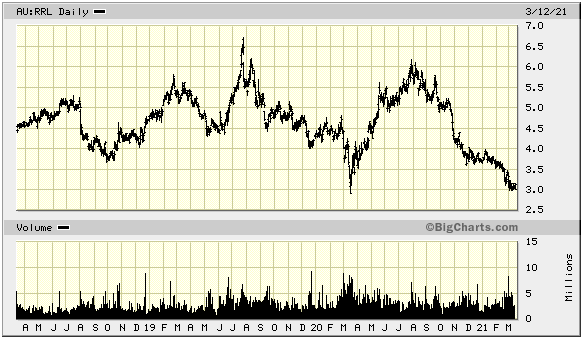
“We can’t identify any ‘screaming buys’ in the gold sector at the moment and we doubt that the gold mining indices/ETFs have made sustainable lows. However, there are prices at which it would make sense to buy certain gold stocks, even taking into account the likelihood that the fundamental backdrop will remain gold-bearish for at least three more months. That’s especially so for investors who currently don’t have much exposure to gold.” We went on to provide three examples of gold stocks that currently were not in the TSI List but would be added if the price were right. They were Regis Resources (RRL.AX), Sabina Gold and Silver (SBB.TO) and US Gold Corp. (USAU). Over the past week none of these stocks traded near our suggested buy prices and there was no significant change in the gold mining sector’s prospects, but near its current price of A$2.99 we think that the intermediate-term risk/reward of RRL.AX is sufficiently attractive to justify its inclusion in the TSI List. As mentioned last week, RRL is a profitable, financially-solid, dividend-paying mid-tier gold producer with a mining operation in Western Australia (Duketon) and a development-stage project in New South Wales (McPhillamys). The company is expected to produce about 370K ounces of gold this financial year (the financial year ending 30th June 2021) and to ramp up its production from the Duketon operation to around 400K ounces/year over the coming 2 years. However, the bulk of the company’s growth potential is associated with the permitting-stage McPhillamys gold project in NSW. McPhillamys has a 2M-ounce reserve, and according to a PFS could be developed into an open-pit gold mine that produces around 200K ounces per year. If permits are received as planned, mine construction could begin before the end of this calendar year. As noted above, the company is profitable. Specifically, it’s likely to have net earnings of A$0.35-$0.40/share for the current financial year, meaning that it is trading at around 8-times this year’s earnings. Furthermore, it should remain very profitable unless there’s an additional large decline in the A$-denominated gold price. As also noted above, RRL is financially solid. At 31st December 2020 the company had no long-term debt and A$186M of working capital. The combination of the strong balance sheet and the low P/E ratio limits the risk. Despite having a lot going for it, RRL’s stock-market performance has been dismal over the past few years. As illustrated below, the stock price is now testing its low of the past three years.
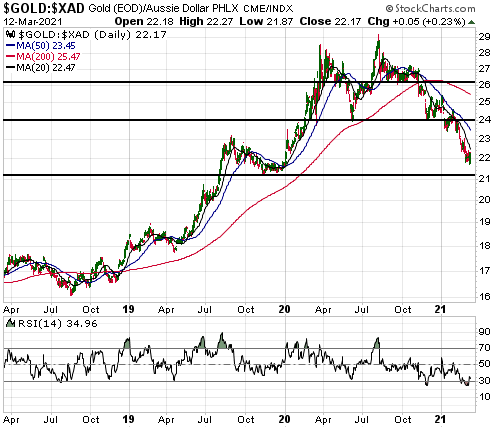
One reason for the stock’s terrible performance is that at times over the past few years there was too much optimism factored into its market valuation. A more important reason, since it remains applicable, is the company’s hedge book. Judging by the average price of the forward sales that comprise RRL’s hedge book today (359K ounces at an average price of A$1617/oz), the sales must have been made while the A$ gold price was basing prior to the start of the major rally of 2018-2020. Forward selling a lot of gold near the end of a gold bear market was a very stupid thing to do. We have no problem with hedging as long as it is done when the price is near a multi-year high. Only the ‘dumb money’ hedges AFTER prices have collapsed. Also, it is possible to hedge without limiting upside exposure and without creating the risk of ending up with a large liability. This is achieved by using put options rather than forward sales. At this time, with the A$ gold price near an 18-month low (refer to the following chart for the gory details), RRL’s management could mitigate the risk associated with its ill-conceived forward sales book by purchasing gold call options to offset the forward sales (a forward (short) sale + a call option is a synthetic put option). However, we aren’t expecting that. Our expectation is that the company will continue to do what it has been doing, which is unwind the hedge book at the pace of about 20K ounces per quarter.
We don’t mind problems we know about and can quantify. We estimate that the hedge book currently constitutes a liability of around A$220M, making it significant but not a deal-breaker. Furthermore, if not for the hedge book we would not have the chance to buy the stock at today’s low price. That is, the hedge book is more of a problem for those who owned the stock over the past three years than for those who buy the stock now. We think that the stock’s short-term risk/reward is neutral, with downside and upside potential of about 15%. However, we think that the stock’s intermediate-term risk/reward is decidedly skewed towards reward, with downside potential of about 15% versus upside potential of at least 60% (we have A$4.70-$5.00 in mind as a 12-month target). Further to the above, RRL has been added to the TSI List as a long-term position. |
Copyright © speculative-investor.com